
Short answer: SEO and Google Ads are not two versions of the same service. SEO builds visibility in unpaid search results; Google Ads lets you pay to reach people under your campaign settings. The right choice depends on what the business needs now, what you can invest, and how you will measure the outcome.
If you need enquiries this week, paid search may be a faster test. If you want to improve your website steadily and answer questions customers ask before buying, SEO is longer-term work. For many businesses, the answer is not “either-or”: the two can work together when each has a clear purpose.
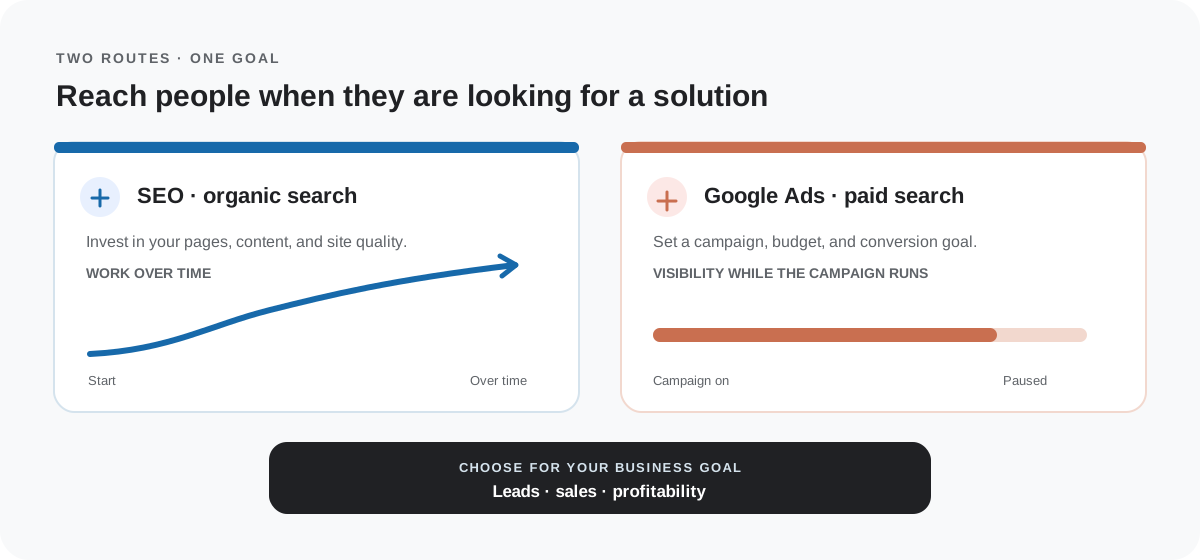
Before comparing the cost per click with the cost of SEO work, ask: which business action do you want to encourage? A phone call, enquiry, visit, sign-up, or sale? Without that answer, it is easy to buy plenty of visits and still not know whether the campaign helped.
Short answer: often, it makes sense to use both
SEO and Google Ads can reach similar people at the moment they search, but they work in different ways. Google states that participating in its advertising programs does not, by itself, increase or decrease a site’s inclusion or position in organic search results. See Google Search Central’s explanation.
Ad spend is therefore not an SEO investment, and SEO work does not set up an advertising campaign. Compare the two by their contribution to your goals, but measure them separately. Ads can provide faster feedback about an offer or landing page; SEO can build a longer-term foundation through useful content, a clearer site structure, and organic visibility that is not bought per click.
SEO and Google Ads: what is the difference?
SEO (search engine optimization) means improving a website and its content so search engines can find, understand, and show pages to people they may help. This can involve accessible pages, clear answers, trustworthy information, useful navigation, and ongoing content work. An organic click does not have a separate Google Ads charge, but SEO takes time, work, tools, or specialist support. Calling SEO “free” is misleading.
Google Ads is a paid advertising platform. A Search campaign can show ads on search results pages to people looking for your products or services. You set a goal, location, language, budget, ad copy, landing page, and bidding strategy. Costs depend on campaign settings and the auction. Many Search campaigns focus on click costs, while the business goal may be conversions or their value.
A quick comparison
| What matters | SEO | Google Ads |
|---|---|---|
| What you invest in | Content, technical access, site structure, time, and expertise. | Campaign impressions or clicks under your settings, plus the work of managing ads. |
| When visibility may appear | Changes and their effects can take time; there is no fixed timeline or ranking guarantee. | Ads may start showing after setup and review, but impressions and results are not guaranteed. |
| What happens when spend stops | Organic results may remain, but they need ongoing work and can change. | Paid campaign visibility ends when the campaign is paused. |
| What is easier to change | Page content, structure, and technical choices; search engines may take time to notice changes. | Budget, audience, ad copy, location, and campaign schedule; results still need monitoring. |
| How to measure it | Organic impressions, clicks, relevant queries, and meaningful business actions. | Spend, conversions, conversion value, and profitability—not just impressions or clicks. |
What has changed in Google Ads?
Google Ads Search campaigns now include more options to automate query matching and ad creation. For example, Google describes AI Max as a set of optimization features within existing Search campaigns, not a separate campaign type. It can include search-term matching, text customization, and final URL expansion. Review Google’s description and the controls available in your account, since access and settings can change.
Automation does not mean you can launch a campaign and stop checking it. Make sure the ad promise matches the landing page, the expanded URL points to the right place, relevant search terms are attracting the campaign, and real conversions are being recorded. Do not promise an offer in an ad if the page does not explain it. Do not commit a budget before you know what value a customer needs to generate.
Google Ads provides a Search terms report and, where available, grouped insights about queries that triggered ads. These can suggest ideas for ad copy or website content. The report does not expose every search: some low-activity queries may be hidden or grouped for privacy. Treat these data as one signal, not a complete map of the market.
When is SEO a better fit?
- Customers look for answers before they decide. Guides, comparisons, and service pages can help at different stages of their journey.
- You have useful expertise to explain. Specific answers and examples from your experience can set your pages apart from generic content.
- You want to build organic reach over time. SEO can help create a more useful, coherent website, but results are not guaranteed and the site needs maintenance.
- Your economics do not support paying for every visitor. That does not make SEO cost-free; compare the full cost of the work with the value it can bring.
SEO is especially useful when a page can help many people who have the same question. Before writing another article, check whether you already have a page that could be improved.
When is Google Ads a better fit?
- You need to test a specific offer or short-term promotion. You can run a campaign for a limited period, but allow time for setup, review, monitoring, and optimization.
- There is clear search demand and a suitable landing page. Ads will struggle if the page does not explain the price, terms, or next step.
- You can measure value accurately. Track enquiries, sales, or sign-ups; otherwise, you cannot tell useful clicks from expensive traffic.
- Your budget and margin can support a test. Start with an amount you can afford to spend while learning, and define when you will adjust or stop the campaign.
Google Ads’ average daily budget is not necessarily a strict cap for each calendar day. For most campaigns, Google says a single day’s spend can reach up to twice the average daily budget, while the monthly spending limit is generally calculated as the budget multiplied by 30.4. Check the official spending limits and the terms in your account before setting a budget.
How to decide: five questions
- What counts as success? Name one main action and its value: a qualified enquiry, sale, booking, or another goal.
- Are people searching for this solution on Google? Check search terms, customer questions, and your website data. A tool or ad metric alone does not prove the demand is profitable.
- How soon do you need results? A short promotion may justify a paid test; sustained demand and informational needs may support SEO work.
- Is your website ready for visitors? Check that the page is clear, works on mobile, explains the real offer, and gives people an easy next step.
- What can you invest, and how will you judge the return? Include not only ad spend but also labor, content, website changes, and the cost of delivering the sale.
Example: a window repair company in Kaunas
The company wants more enquiries for “window adjustment in Kaunas.” A Google Ads campaign could test whether a clear offer and appropriate local targeting generate calls. The company should track calls and the quality of enquiries—not treat every click as a sale.
At the same time, it can improve its service page: explain which windows it repairs, where it works, the starting price or how the price is calculated, how to book a visit, and what happens after an enquiry. That is SEO work, but it can also improve the landing page used for ads. If customers often search “why is my window fogging up,” the company could publish a helpful explanation that separates common causes from cases that need a technician.
After the test, make the next decision using real data: total spend, relevant enquiries, bookings, and remaining margin. If the campaign is not profitable, the answer is not automatically to increase the budget; the offer, page, targeting, or measurement may need work.
How to start with both
- Set up measurement. Check that enquiries, calls, or sales are recorded and that their reported value is meaningful.
- Choose one high-intent topic. Pick a query that clearly relates to your offer and decide which page should answer it.
- Improve that landing page. Add a clear answer, pricing approach, proof, and an easy next action.
- If you test ads, keep the test bounded. Set the location, language, budget limit, conversions, and negative keywords; review search terms regularly.
- Base SEO work on a content gap. Create or improve pages that help customers before they enquire, then connect them to relevant service pages.
- Review results after an agreed period. Compare spend, qualified enquiries, sales, and organic visibility separately. Do not credit one tactic for every change if several things changed at once.
What not to confuse
- “I ran ads, so my SEO improved.” Advertising does not directly raise organic rankings.
- “Organic traffic costs nothing.” It has no ad click charge, but content and website optimization require investment.
- “Ads guarantee customers.” Ads can bring visits, but outcomes depend on the offer, landing page, competition, measurement, and other factors.
- “SEO guarantees the top position.” Neither an SEO professional nor a site owner can guarantee a specific ranking or date.
- “More clicks mean more profit.” Visitor quality and whether people become customers at a sustainable cost matter more.
Frequently asked questions
Do Google Ads improve my SEO rankings?
No. Google says participation in its advertising program does not, by itself, affect inclusion or positions in organic results. Ads can be a useful separate channel, but the budget is not a ranking fee.
Is SEO free compared with Google Ads?
No. Organic clicks do not have an ad charge, but SEO takes work: reviewing the website and content, making changes, checking the results, and maintaining the site. Compare the full investment with the outcomes.
Where should I start if my budget is small?
First check the landing page, offer, and measurement. If people are actively searching for your service and you can track the value of enquiries, a small, bounded ad test may provide faster feedback. If you do not have a suitable page or cannot evaluate enquiry value, fix those gaps before expanding a campaign.
Can I run Google Ads myself?
Yes, but define a clear goal and budget limit, and check location, language, landing page, and conversion tracking. Review search terms and spend regularly after launch. If AI features are enabled, check which text and pages they may use.
Should SEO and Ads always run together?
No. Combine them when they support different parts of the same goal and you can evaluate each separately. If your budget or team is small, start with the biggest constraint: the landing page, the offer, measurement, or demand validation.
The takeaway
SEO helps build organic visibility and useful pages over time. Google Ads lets you pay to test and reach search demand while a campaign is active. One does not automatically replace the other, and ad spend does not buy organic rankings. Choose according to your timeline, budget, website readiness, and measurable business goal; if both fit, use them as related but separately measured channels.
Next in the plan: How much does SEO cost, and what are you really paying for?
Next guide: SEO Pricing: What Are You Really Paying For?
Sources and official guidance
- Google Search Central: Does advertising affect organic rankings?
- Google Ads: Create a Search campaign
- Google Ads: Manage your spend
- Google Ads: Search terms report
- Google Ads: AI Max for Search campaigns
Reviewed October 15, 2026. Check Google Ads settings and official guidance before changing a campaign.
Back to the top ↑