
In this guide
An SEO audit is a review that should lead to decisions. Its purpose is to explain what prevents important pages from being found, what to fix first and how to verify the work. A long list of warnings is only useful when someone turns it into a practical plan.
Imagine a small online shop. A tool reports hundreds of image warnings, while a key product category accidentally carries a noindex directive. Renaming images might be easy. Investigating the category's indexing barrier is likely a better starting point. An audit should help you make that distinction.
When do you need an audit?
Consider one before a migration, after a major redesign, when organic traffic falls unexpectedly or before investing in new content. A review also helps when visitors arrive but cannot find the right service or complete an important action.
A small site does not automatically need an extensive project. With ten pages and a specific concern, a focused consultation may be enough. Start with a question: “Why are our service pages not indexed?” is more useful than “Improve our SEO score.”
Six areas worth checking
1. Business goals and measurement
Choose the pages and actions that matter: an enquiry, purchase, registration or call. Record the starting position. Search Console helps explain search visibility, while site analytics and enquiry records describe visitor actions. These sources measure different things, so their figures do not have to match.
2. Access and indexing
Do important URLs work, return the appropriate response and avoid accidental restrictions? Review noindex directives, robots.txt, canonical URLs, redirects and the sitemap. Including a URL in a sitemap does not guarantee indexing. In Search Console's URL Inspection tool, distinguish the last known indexed state from a live page test.
3. Structure and internal links
Can a visitor reach important information from the home page or a relevant category? Do links explain their destinations? Identify pages with no internal links and unnecessary detours. Not every filter combination or duplicate address needs to appear in search.
4. Content and the reader's task
Compare the promise of a page with what it delivers. Someone searching for audit costs needs more than a definition: explain scope, pricing and deliverables. Check accuracy, first-hand experience, examples, headings and overlapping topics. A longer article is not automatically a better answer.
5. Mobile usability and speed
Follow the main visitor journey on a phone: read the page, open the menu and complete the enquiry action. Look for small text, unexpected movement, oversized images and intrusive ad placements. Interpret PageSpeed Insights lab tests alongside real-user data when available. One overall score cannot describe the entire experience.
6. Languages and search presentation
On a bilingual site, check that the language switch opens the equivalent translation and that canonical and hreflang links are correct. Structured data must match visible content. Valid markup does not guarantee an enhanced search result.
Your first practical review
- Select five important URLs and write down the purpose of each.
- Open them on a phone. Test navigation, links and the main action.
- Inspect those URLs in Search Console and record indexing discrepancies.
- Compare the last 28 days of search performance with the previous period. For seasonal businesses, also consider the previous year when data is available.
- Choose three evidence-based tasks. Give each an owner and a verification date.
Download the SEO audit worksheet (CSV)
Open the file in a spreadsheet. It contains review questions and space for URLs, evidence, priority, ownership and results. It helps organise the work; it does not replace a specialist review of a complex site.
What should an auditor deliver?
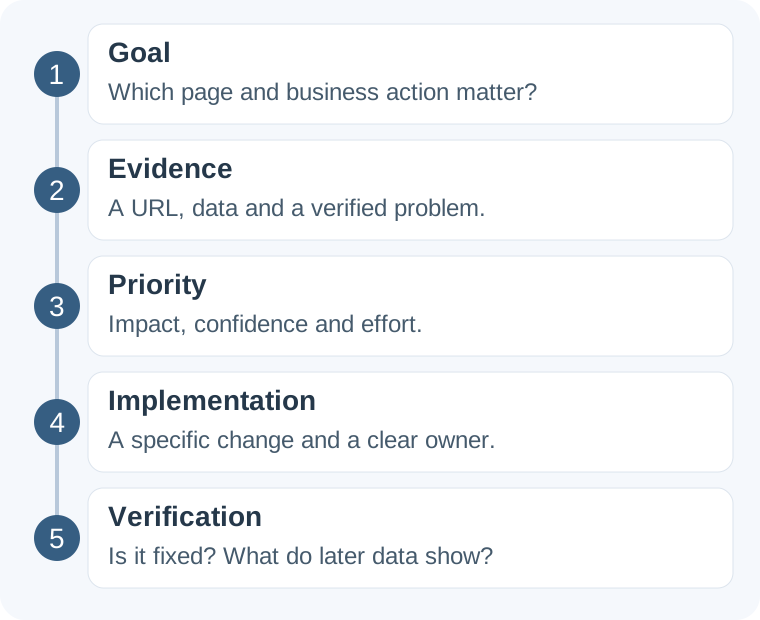
Ask to see a sample before commissioning the work. Each important finding needs a specific URL or page group, supporting evidence, an explanation, a proposed action and an acceptance check. Tool exports can be useful appendices, but the main report should identify priorities.
| Weak finding | Useful task |
|---|---|
| “Indexing issues” | Identify an important category URL with an accidental noindex directive, assign its removal and verify the live page. |
| “More content needed” | A service page omits scope and process. Add clear answers based on the actual service. |
| “More links needed” | Three related guides omit a relevant service page. Add helpful contextual links in specific places. |
These are illustrative examples, not findings from this website or a client audit. The handover should also explain who will implement each task, what requires a developer and which areas were not assessed.
How to prioritise the work
Start with critical barriers affecting important pages. Then weigh potential benefit, confidence in the finding and implementation effort. Red warnings in a tool do not all have the same business impact.
- P1: an important page is broken or has an accidental indexing barrier.
- P2: a page is accessible but lacks a useful answer or relevant internal links.
- P3: a smaller improvement that can be bundled with other work.
These labels are a suggested workflow. Actual priorities depend on evidence and impact, not on a universal checklist.
How much does an SEO audit cost?
A price means little without scope. Reviewing a few representative pages, investigating a large ecommerce site and planning a multilingual migration are different projects. This guide does not present an unverified market average.
Request two or three comparable proposals. Each should specify site coverage, review areas, languages, data sources, deliverables, a handover discussion and any follow-up verification. Clarify whether fixes, development, content production and taxes are included.
Budget for three parts: analysis + implementation + verification. A cheap report is not a saving if nobody knows what to do next. Read more about what makes up SEO costs.
Do you need a separate AI audit?
For Google's AI search features, start with established SEO fundamentals. Google does not specify mandatory special AI markup or a separate set of technical requirements for these features. Indexing, helpful information and accessible content remain relevant. None of these guarantees inclusion in an AI answer.
If a proposal covers other answer platforms, ask which platform, prompts, language, test dates and limitations are involved. A single screenshot does not demonstrate consistent visibility. A provider should distinguish observation from causal impact and avoid promising guaranteed citations.
What happens after the audit?
Check an implemented change immediately: does the page work, is the directive correct and does the link open? Assess search effects later, once enough data is available. Successfully fixing a technical issue and improving rankings are different outcomes.
Record change dates, compare similar periods and consider seasonality, demand and other site updates. Revisit priorities monthly and consider a broader review after a migration or substantial change. You do not need to buy the same complete audit every month.
Common questions
Can a free tool replace an audit?
It can reveal problems, but it does not know all your goals or the reasons behind your site's decisions. Validate its findings and relate them to important pages.
What access should I provide?
Give the necessary read access for the initial review rather than all administrator credentials. Agree implementation permissions separately. Google's guidance on hiring an SEO supports this approach.
Does an audit guarantee better rankings?
No. It supports informed decisions. Results also depend on implementation, competition, demand and search systems.
Sources and your next step
- Google: hiring an SEO and defining audit scope
- Google: AI features and your website
- Google: technical search requirements
- PageSpeed Insights
If you plan to hire help, read the questions to ask an SEO specialist. To organise your own work, follow the SEO methodology guide.